
The journal: education
What Is a Break of Structure (BOS)? How the LS Model Reads Trend
Trend is the first thing the LS Model establishes, and it's built entirely on one idea: the break of structure. Get this right and everything downstream — your levels, your entries, your bias — has a foundation. Get it loose and you'll read trends that aren't there.
Here's what a break of structure (BOS) is, and how the model uses it.
The core idea
Price moves in swings — highs and lows. A break of structure happens when price pushes past one of those prior swing points. But the model is strict about what counts.
A BOS is confirmed by a candle body close beyond the prior swing. A wick through the level is not enough.
That distinction does a lot of work. Price wicks through levels constantly — chasing every wick gives you false breaks all day. Requiring the body to close beyond the swing filters out the noise and only flags moves the market actually committed to.
- Bullish BOS: a candle body closes above the prior swing high.
- Bearish BOS: a candle body closes below the prior swing low.
How a BOS defines the trend
One break isn't a trend. The model reads trend on the 30m — its top timeframe, with no higher filter above it — and looks for repetition.
Multiple breaks of structure in the same direction (two or more) over the past two to three trading days is the trend. That repeated, same-direction breaking is what you're trading with. Mark the latest 30m break — that's your reference point for the current leg.
If the 30m is mixed or ranging, with no clear repeated breaks one way, there's no trend and no trade. Stand down. The model would rather you sit out than manufacture structure that isn't there.
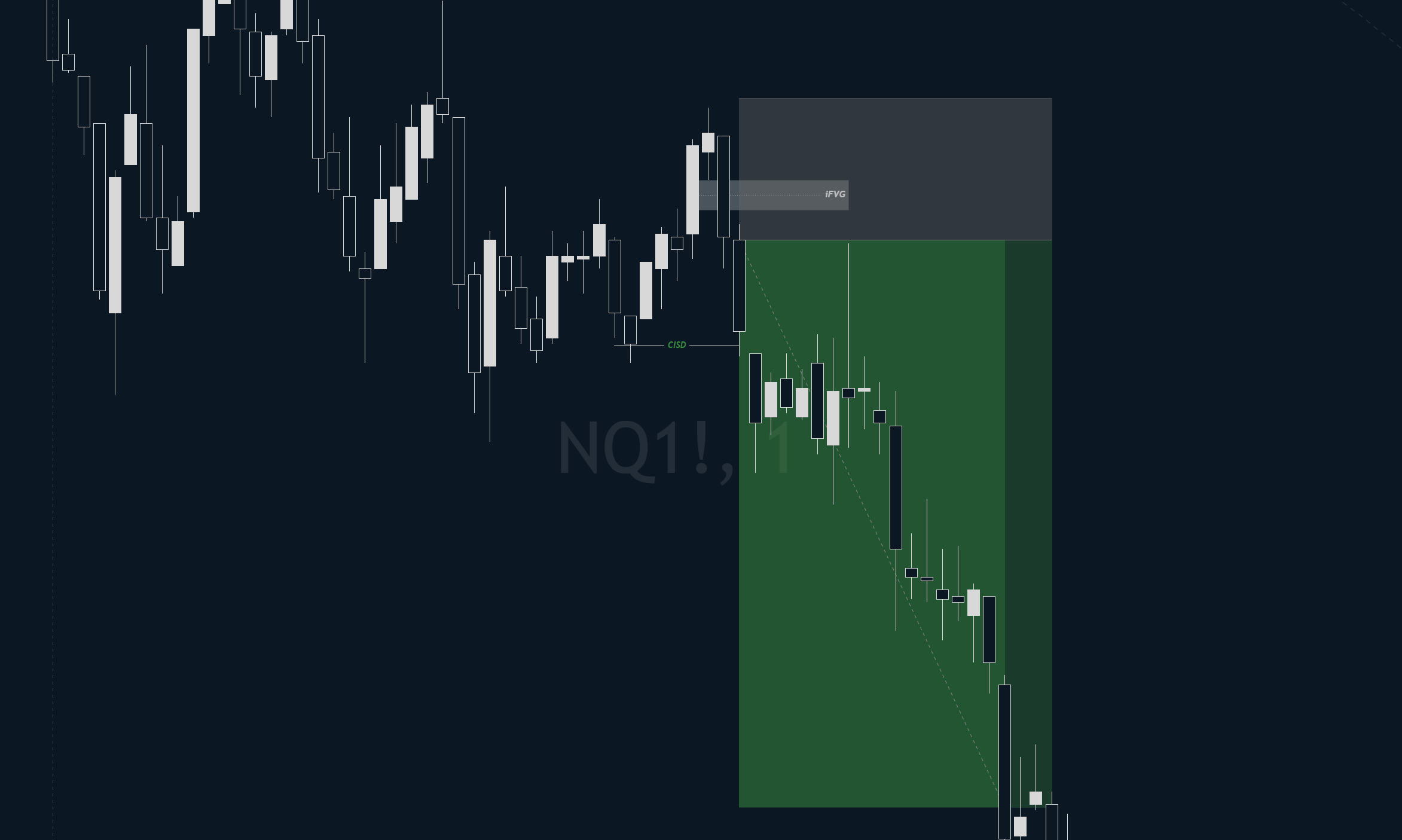
ChoCh: the first crack in the trend
Trends end. The first sign is a counter-trend break of structure — a ChoCh (change of character).
A ChoCh is the first BOS against the established direction. If price has been making higher highs and higher lows and then a candle body closes below a recent swing low, that's a ChoCh. It doesn't mean the trend is dead, but it's a warning: the bias may be about to flip.
It's the same confirmation rule, just pointing the other way — body close, not a wick. When a ChoCh shows up, you stop looking for with-trend continuations and start watching for a possible bias flip.
The one thing to take away
Before you call any break a break, ask one question: did a candle body close beyond the swing, or did it just wick through? If it's only a wick, there's no BOS — wait. That single discipline removes most false trend reads on its own.
Where this fits
A break of structure tells you which way the market is committed. The next question is what to do when price pulls back and a BOS points the other way — that's a possible reversal. What Is a Bias Flip? covers how the model reads and trades that.
Lewis trades the New York session live, in public, on YouTube and TikTok. Learning the LS Model? Start free with the public sessions and the sheets. The full course library is in The Debrief Plus.
Educational only. This is not financial advice. Trading leveraged instruments carries substantial risk, and past results don't guarantee future ones. The LS Model is a methodology. VIP alerts are free with an Exness account; you place each trade yourself. No Exness where you are? VIP comes included with The Debrief Plus or LSTrades Copy. Join the free Discord community and learn the structure read with other traders.
Free: the NY-open checklist
Get the session-prep checklist I run before the New York open.
The exact pre-market routine: the 30m read, the level, the risk rules, the debrief. Plus The NQ Edge letter. No hype.
VIP signals are free with Exness
My trades and our bot's trades, in your Telegram.
Entry, stop, targets, and the management as it happens, losses included. Free with an Exness account under the partnership.