
What Is an iFVG? The Entry Signal Behind Every LSTrades Alert
If you've seen an LSTrades alert fire in Discord, you've seen an iFVG in action. It's the entry mechanism. Every signal — whether graded A, A+, or A++ — requires a confirmed iFVG. No iFVG, no trade.
Here's what it is and why it matters.
What Is a Fair Value Gap (FVG)?
A Fair Value Gap is a three-candle price imbalance. It forms when a strong directional candle moves so aggressively that it creates a gap between the wick of the candle before it and the wick of the candle after it.
That gap represents inefficiency — price moved too fast for the market to fully process. On a 5-minute NQ chart, you'll see FVGs form frequently during news events, session opens, and institutional order flow bursts.
What Makes It Inverted (iFVG)?
An FVG becomes an inverted Fair Value Gap (iFVG) when price trades back through it from the opposite side.
Here's the sequence:
- A bullish FVG forms — price gaps up, leaving an imbalance below
- Price later retraces back down into that gap
- When price enters the FVG from the top (coming back down), the gap has been inverted
That re-entry is the entry trigger. The iFVG marks the exact zone where the original displacement began — and where institutional orders are likely to defend.
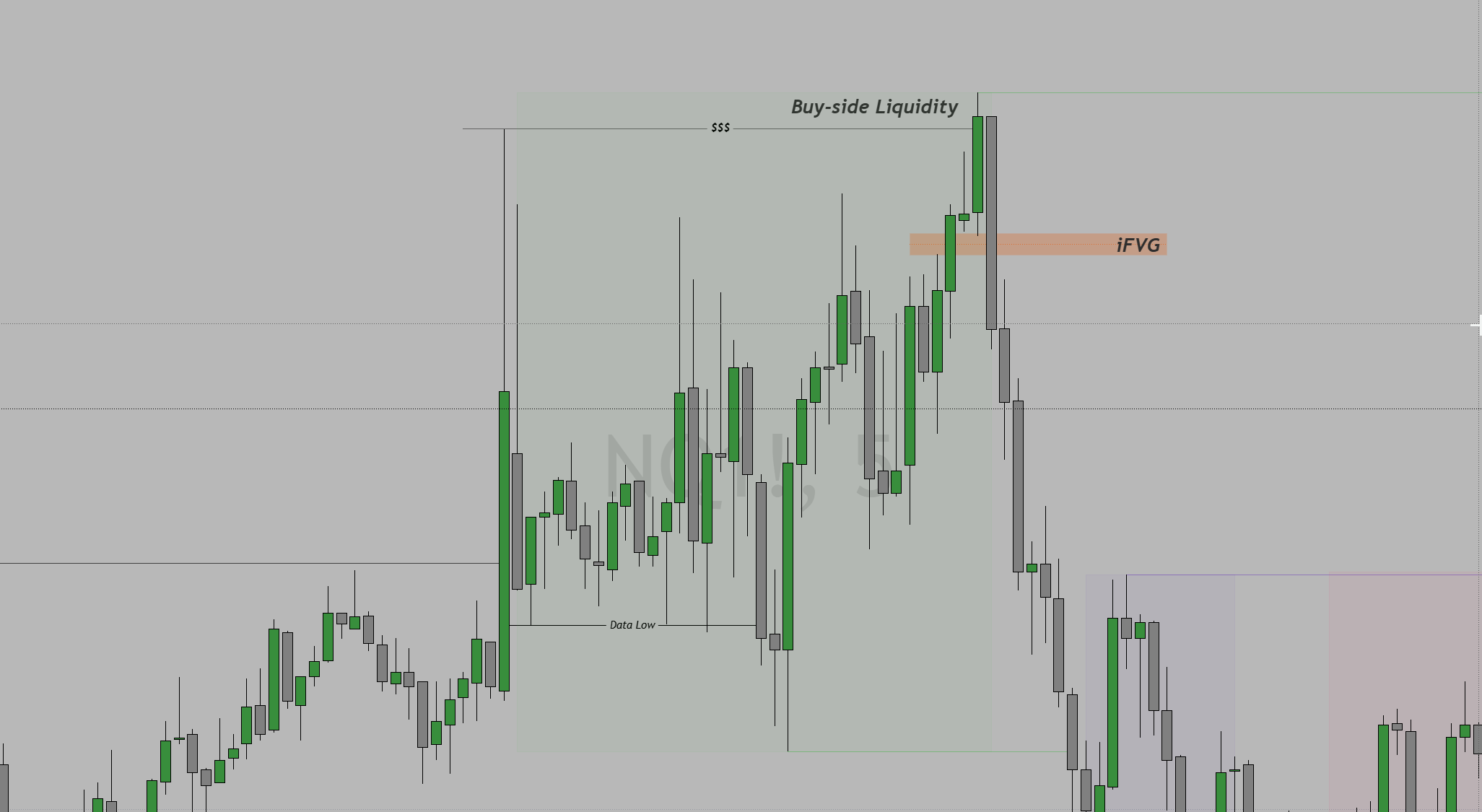
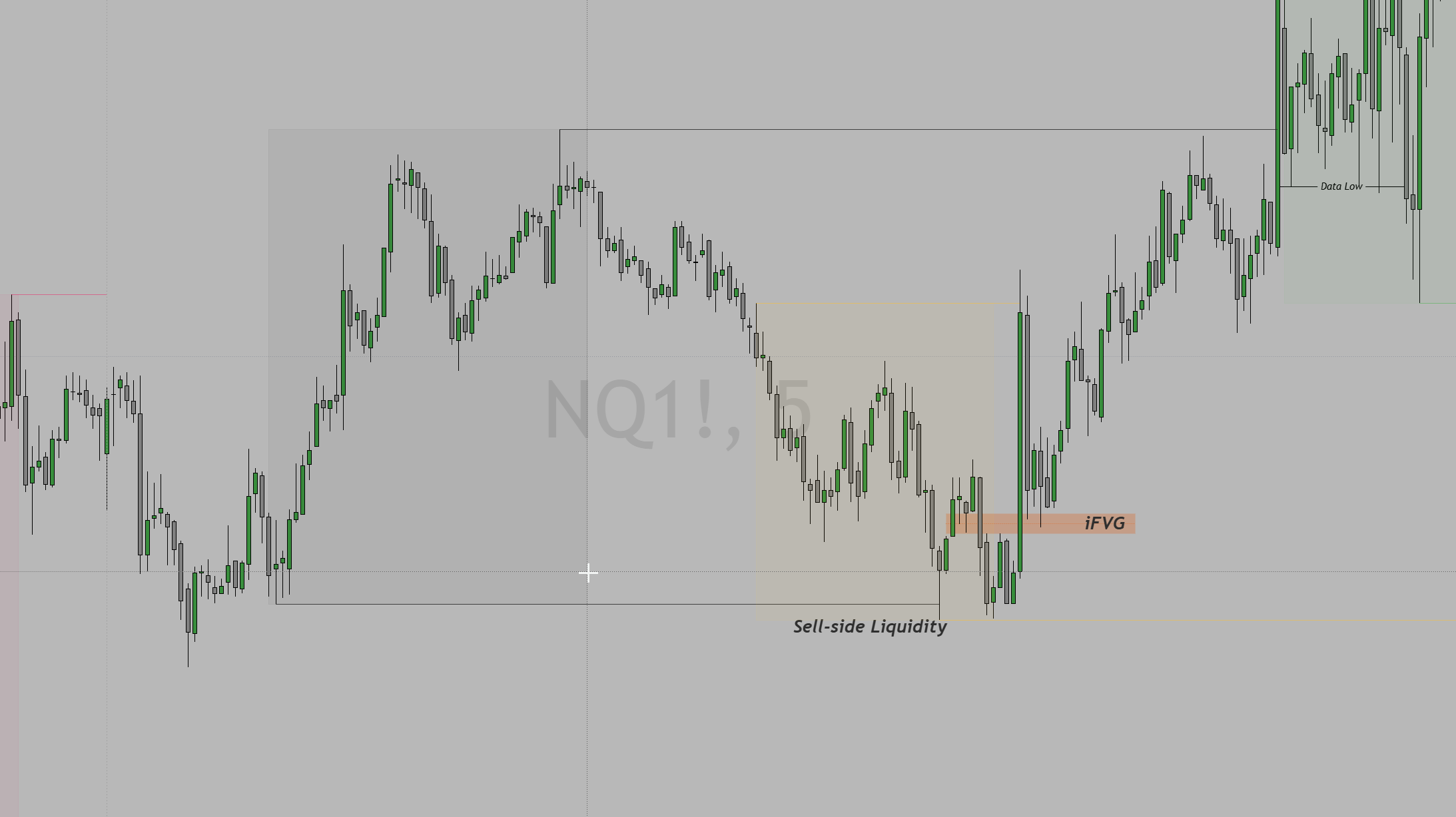
In a bearish setup, the inversion works the same way in reverse: a bearish FVG forms, price retraces upward into it, and the entry triggers on that re-entry.
Why the Inversion Matters
An FVG on its own is common. An inverted FVG is specific.
When price returns to fill an imbalance, it's doing two things simultaneously:
- It's providing liquidity (filling orders that didn't get filled on the initial move)
- It's testing whether the original directional intent is still valid
If the institutional order that created the FVG is still in play, price will respect the inversion and continue in the original direction. If not, price will slice through it — and that's not a setup worth taking.
The LSTrades system only fires an alert when the iFVG forms after a confirmed liquidity sweep. That combination — sweep then iFVG inversion — is the core of the methodology.
The Full Setup Sequence
A signal requires these steps in order:
- Liquidity swept: Price takes out a pool of resting orders (buy stops above a swing high, or sell stops below a swing low) and reverses
- FVG created: The reversal candle is strong enough to create a price imbalance
- iFVG inversion confirmed: Price retraces back into that FVG zone from the opposite side
When all three steps are present, the entry is valid. The iFVG zone itself defines the entry range — you enter as price enters the zone, with a stop loss placed just beyond it.
This sequence happens in the NY AM session, 9:30 AM – 11:30 AM EST. The session timing matters: institutional participation is highest in this window, which means sweeps are cleaner and iFVG inversions are more likely to hold.
How Signals Get Graded
Not every iFVG setup carries the same weight. The LSTrades grading system adds context:
| Grade | What it means | |-------|---------------| | A | Sweep + iFVG inversion confirmed (base model conditions met) | | A+ | Above + one confluence factor (CISD, BPR, or HTF FVG alignment) | | A++ | Above + two or more confluence factors |
An A-grade setup is valid and tradeable on its own — the core sequence fired. A+ and A++ reflect how much additional confluence supports the trade: CISD (Change in State of Delivery) confirms structural momentum on the 5-minute timeframe, BPR (Balanced Price Range) indicates an FVG sandwich, and HTF FVG alignment means the sweep hit a higher-timeframe imbalance zone. The more confluences, the stronger the signal.
Where to Place Your Stop Loss
The iFVG zone does more than define the entry — it anchors the stop loss.
For a long setup:
- Entry: as price re-enters the iFVG from the top (iFVG inversion)
- Stop loss: below the low of the FVG zone (the bottom of the imbalance)
For a short setup:
- Entry: as price re-enters the iFVG from the bottom
- Stop loss: above the high of the FVG zone
This placement is logical, not arbitrary. The FVG zone represents a price region the market should not revisit if the setup is valid. If price closes through the full zone, the imbalance has been filled and the thesis is invalidated.
The LSTrades indicator calculates the SL automatically and includes it in every Discord alert.
What to Watch For
If you're following NQ with a chart, here's how to spot these setups manually:
- Watch for price sweeping a prior swing high or low in the 9:45–11:00 AM EST signal window
- Look for the reversal candle — it should be decisive, not a small body
- If a three-candle gap forms on that reversal, mark the zone
- Wait for price to retrace back into that zone from the opposite side
- That re-entry is the iFVG inversion — the signal trigger
In practice, this happens fast. The inversion often completes within 2–4 candles of the original sweep. Speed is why the automated indicator exists.
The Full Picture
The iFVG isn't a standalone concept. It's the third step in a sequence: liquidity swept → price displaced → imbalance inverted.
Blog Post #1 covers the first step — what a liquidity sweep is and why it's the required gate for every LSTrades signal.
Once you understand both pieces, the logic of the grading system clicks. A-grade means the core sequence fired. A++ means everything aligned.
Want to see live examples? Join the LSTrades community on Discord — every signal is posted in real-time with grade, entry, SL, and TP targets. Or see the full access tiers if you're ready to go further.
Want to sit in the room?
Trade NQ live with me every NY open.
Pre-market read, the entry called as price gets there, full debrief after. You watch the read, not just the result.