
How to Grade Trade Setups: The A / A+ / A++ Framework
Every setup that passes the LSTrades signal filter is valid. The liquidity sweep confirmed. The iFVG inverted. The session timing is right.
But within valid setups, there's a spectrum. Some have one thing going for them. Others have everything aligned.
The grading system exists to tell you the difference — instantly, before you need to make a decision.
Why Grade at All?
Most trading systems are binary: signal fires or it doesn't. That's useful, but it leaves a question unanswered: how strong is this setup?
A trader who knows a signal is valid but barely meeting minimum conditions will manage that trade differently than a trader who knows every possible confluence factor is stacked in their favor.
The grading system gives you that information in a single letter. No analysis paralysis. No second-guessing. Just: A, A+, or A++.
The Three Grades
A Grade — Base Conditions Met
An A-grade signal means the core methodology fired:
- A liquidity sweep occurred during the NY AM session, with the signal firing in the 9:45 – 11:00 AM EST window
- Price reversed after the sweep and created a Fair Value Gap
- That FVG was inverted (price re-entered it from the opposite side)
- The iFVG inversion happened within the signal window
This is the minimum viable signal. The structural sequence is complete. The trade has edge.
What it doesn't have: additional confluence. The sweep may have happened at a relatively weak level. The broader trend may not fully agree. The trade works on its core mechanics alone.
A+ Grade — One Confluence Factor
An A+ signal has everything an A has, plus one additional factor that strengthens the thesis:
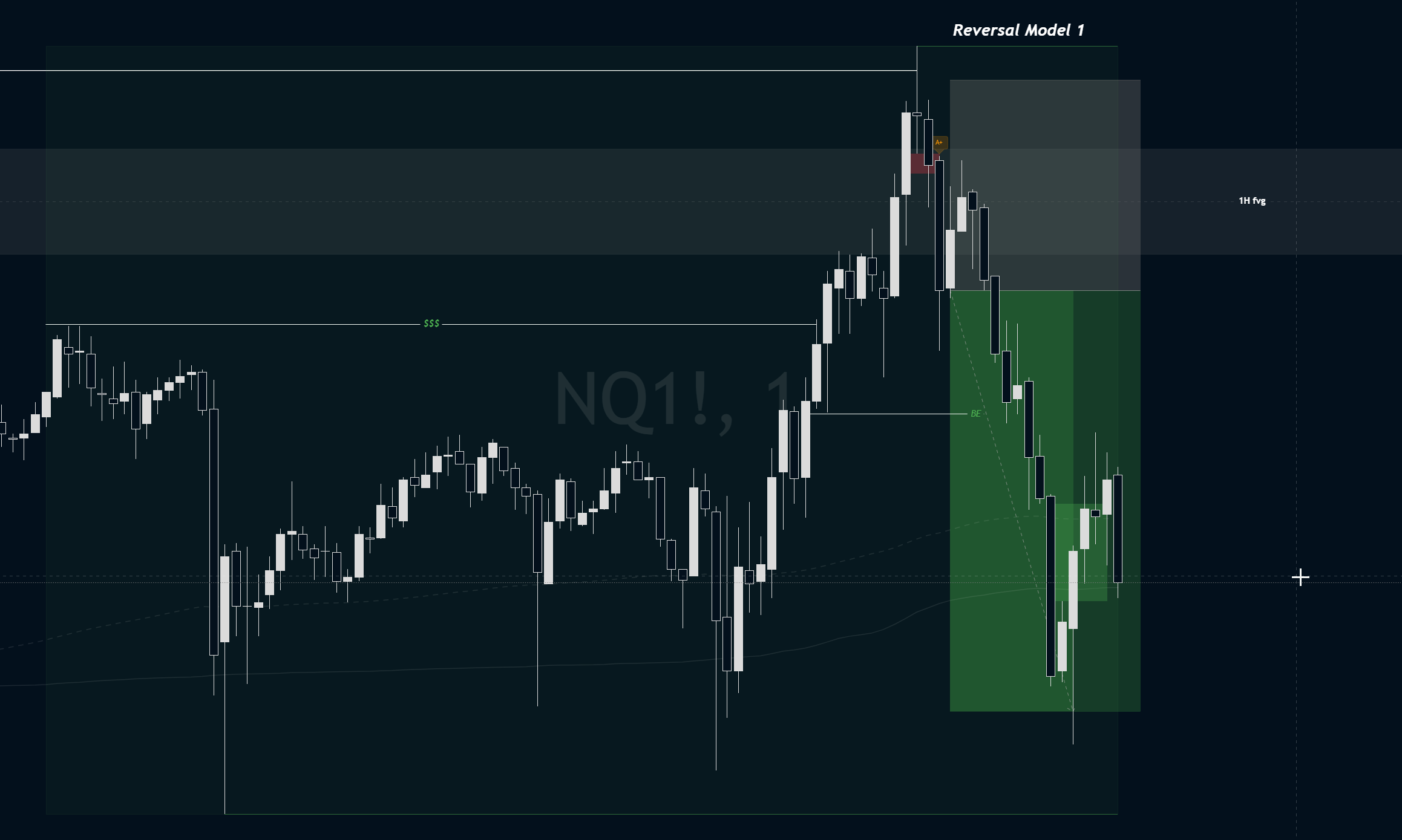
HTF FVG alignment — The liquidity sweep happened into a higher-timeframe Fair Value Gap zone (15-minute, 1-hour, or 4-hour). This means the sweep didn't just raid a cluster of stops — it drove price into a zone where a larger-timeframe imbalance exists. Institutions are more likely to defend these zones.
CISD confirmation — A Change in State of Delivery has occurred on the 5-minute timeframe in the trade direction. Price has closed through a swing level, confirming a structural shift. The trade direction aligns with confirmed market structure.
BPR (Balanced Price Range) — A bullish and bearish Fair Value Gap overlap, creating a price sandwich. This overlapping zone acts as a magnet and support/resistance area, adding another layer of confluence to the entry.
Any one of these upgrades the signal from A to A+.
A++ Grade — Full Alignment
An A++ signal has everything:
- Sweep + iFVG inversion (base conditions)
- HTF FVG zone alignment
- Multi-timeframe trend agreement — 4H, 1H, 15m, and 5m all confirm the same direction
This is the highest-conviction signal the system can produce. The trade is supported by the core entry model, a higher-timeframe institutional zone, and structural agreement across every timeframe the indicator monitors.
A++ signals are the rarest. When they fire, everything is aligned.
The Grade Table
| Grade | Requirements | Conviction | |-------|-------------|-----------| | A | Sweep + iFVG in the 9:45–11:00 AM EST window | Valid — core sequence confirmed | | A+ | Above + 1 confluence (HTF FVG, CISD, or BPR) | Strong — additional institutional alignment | | A++ | Above + HTF FVG alignment + all timeframes agree | Highest — everything aligned |
Note: The indicator's default minimum grade is set to A+. Signals graded below the minimum are suppressed — they won't fire or appear in Discord. You can lower the threshold to A or raise it to A++ in indicator settings.
How to Use the Grades
Position sizing
Some traders size their positions based on the grade:
- A grade: standard position size
- A+ grade: slightly larger position (the thesis is stronger)
- A++ grade: maximum position size (full conviction)
This is a personal risk management decision, not a system rule. The LSTrades system fires the same entry/SL/TP structure regardless of grade. But the grade gives you the information to make that call.
Trade selection
If you're a selective trader who only wants to take the highest-probability setups, you can filter by grade. Only trading A+ and above means fewer signals but higher average confluence.
If you're a systematic trader who takes every signal, the grade helps you set expectations. An A-grade trade that hits SL doesn't mean the system failed — it means a base-conditions setup didn't work out. That's expected.
Journaling
Track your results by grade. Over time, you'll see whether your edge is concentrated in A++ setups or distributed across all grades. This data informs how you allocate attention and capital.
Model Classification vs Grade
Signals also carry a model classification: RM1, RM2, or CONT. This is separate from the grade.
- RM1 (Reversal Model 1): The sweep occurred into a higher-timeframe FVG zone. First iFVG entry is taken.
- RM2 (Reversal Model 2): The sweep occurred but no HTF FVG was present. Requires a second sweep (manipulation) before the iFVG entry is valid.
- CONT (Continuation): The trade is in the same direction as a prior CISD. No new sweep required — the prior session sweep is still in play.
The model tells you what type of setup fired. The grade tells you how much confluence supports it. An RM1 can be graded A or A++ depending on the other factors present.
What the Grade Doesn't Tell You
It doesn't predict the outcome. An A++ signal can still hit SL. Markets are probabilistic. The grade measures confluence, not certainty.
It doesn't account for news events. A graded signal during FOMC or NFP carries different volatility risk than one on a quiet Tuesday. The system doesn't grade for macro context.
It doesn't replace risk management. Every trade — regardless of grade — has a defined stop loss, TP1 at 1R (20% partial), breakeven at 1.5R, TP2 at 2R (40% partial), and TP3 at 3R (final 40%). The risk structure is the same. The grade informs confidence, not exposure.
Seeing It in Practice
On the LSTrades indicator, the grade appears:
- On the chart: As a label on the signal marker (triangle arrow)
- In the Signal Log Table: Next to each trade entry
- In Discord alerts: As part of the formatted message
- In the tooltip: Hover over any signal to see exactly which factors earned the grade
The Confluence Table (a real-time dashboard on the chart) shows the current state of every grading factor — MTF trend, HTF FVG status, CISD, and sweep status. Before a signal fires, you can already see what grade it would receive.
New to the LSTrades methodology? Start with What Is a Liquidity Sweep? and What Is an iFVG? to understand the core entry model. Then join the Discord to see graded signals fire live.
Want to sit in the room?
Trade NQ live with me every NY open.
Pre-market read, the entry called as price gets there, full debrief after. You watch the read, not just the result.