
The journal: education
Nasdaq Session Times: When to Trade NAS100
The Nasdaq trades nearly 24 hours a day, 5 days a week. But whether you take it as NQ futures or as a NAS100 CFD priced off them, most of those hours don't matter. The session map below uses the futures clock because that's where institutional liquidity lives; CFD trading hours vary by broker, so map these windows to your broker's schedule.
The difference between a profitable Nasdaq trader and a frustrated one often comes down to one thing: knowing which hours to trade and which to ignore.
Here's the full breakdown of Nasdaq session times, what happens in each window, and why one specific session produces the majority of high-probability setups.
The Sessions
Nasdaq sessions follow a global clock. Each session reflects when a major financial center is active:
| Session | Time (ET) | What Happens | |---------|-----------|--------------| | Asia | 8:00 PM to 12:00 AM | Quiet. Low volume. Ranges build. | | London | 2:00 AM to 5:00 AM | Moderate activity. Fake moves and early liquidity sweeps. | | NY AM | 9:30 AM to 11:00 AM | Peak volume. US equities open. The action window. | | NY Lunch | 12:00 PM to 1:00 PM | Consolidation. Volume drops. Avoid. | | NY PM | 1:30 PM to 4:00 PM | Second wind. Institutional repositioning. |
These times are in Eastern Time (ET). Mark each session's boundaries on your chart manually. The sessions themselves are what define where liquidity builds and where it gets swept.
Why the NY AM Session Matters Most
The NY AM session (9:30 to 11:00 AM ET) is when Nasdaq comes alive. US equities open at 9:30 AM, institutional desks are fully staffed, and the volume required for clean price action is present.
Here's what makes this window special for Nasdaq specifically:
Liquidity and volume peak. The largest participants in Nasdaq (hedge funds, prop firms, market makers) execute the bulk of their positioning during the first two hours after the US equity open. This creates the displacement candles and sharp reversals that form clean setups.
Liquidity sweeps are cleanest. When institutions need to fill large orders, they drive price into pools of resting stops (at prior day highs/lows, overnight extremes, etc.). During the NY AM session, there's enough volume for these sweeps to execute fully and reverse, not chop around the level for hours.
Follow-through is highest. A reversal after a sweep during peak volume is more likely to reach its profit targets than the same pattern during Asia or London. The market has the participation to sustain directional moves.
This is why the LS Model concentrates on this window. Setups only form during the session: no overnight reads, no London session noise.
Why the Window Is 9:30 to 11:00
The NY AM window Lewis trades is 9:30 to 11:00 AM ET, tied directly to the US equity open, not a separate narrower slice further into the morning.
Why this window and not the full session?
- The 9:30 open is what triggers the volume and displacement that produce sweeps in the first place.
- After 11:00, momentum fades and price action gets choppier as lunch hour approaches. The 11:00 to 11:30 stretch is excluded for this reason.
- The 9:30 to 11:00 window captures the post-open liquidity sweeps and the first major reversal: the highest-probability stretch of the day.
This is a process window, not a script. The model still requires the sweep-then-bias-flip sequence to actually form: the window just tells you where to concentrate your attention.
What Each Session Produces
Asia (8:00 PM to 12:00 AM ET)
Asia session on Nasdaq is typically low-volume consolidation. Price builds a range, and that range becomes a liquidity target for later sessions.
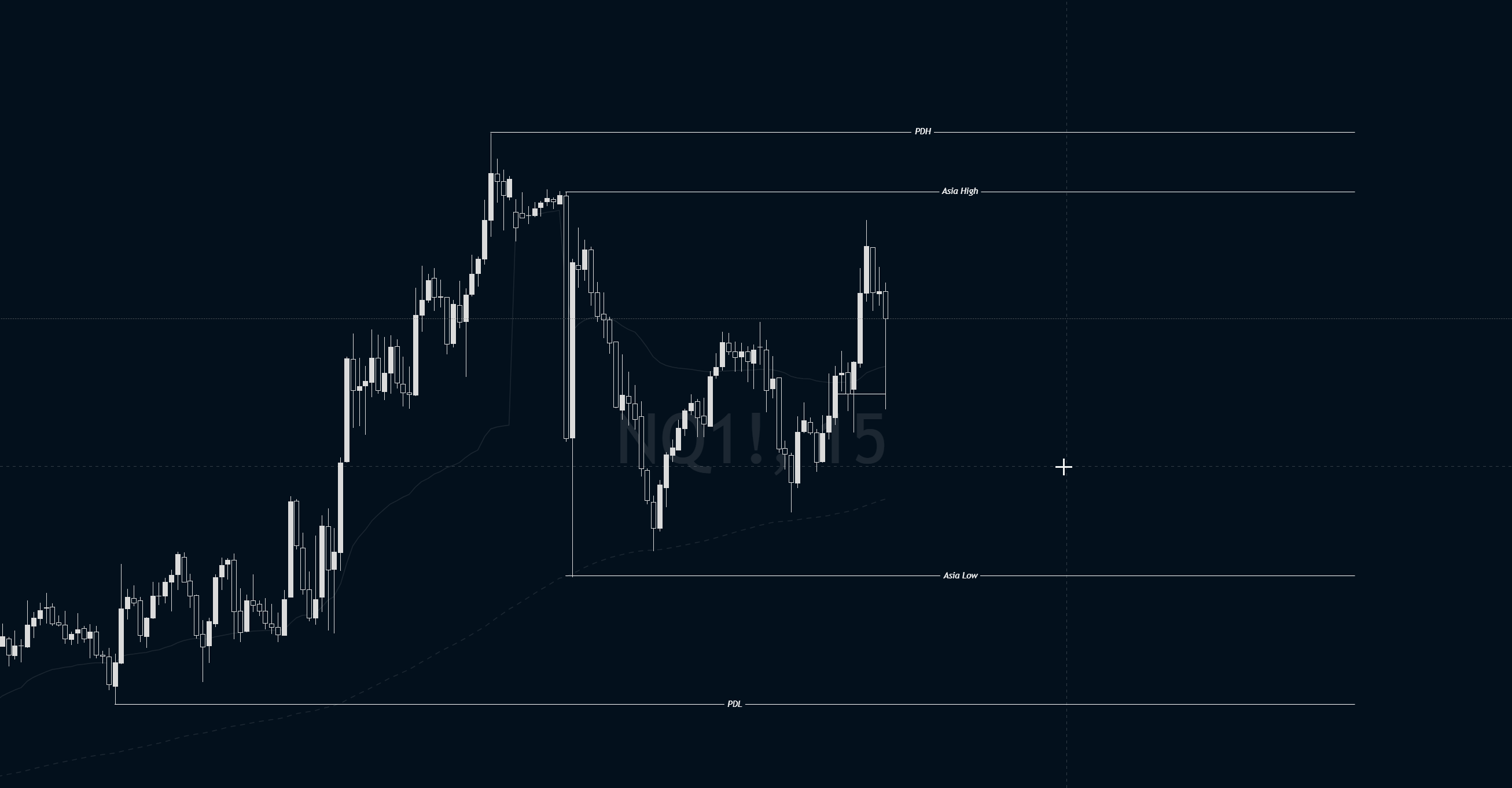
What to note: Mark the Asia session high and low. These levels are potential sweep targets. When the NY AM session opens, price frequently raids one of these levels before reversing.
London (2:00 AM to 5:00 AM ET)
London brings moderate volume and often produces the day's first liquidity sweep. Price may sweep the Asia range high or low, setting up the directional bias for NY.
What to note: London session highs and lows are also worth marking as liquidity levels. A London sweep of the Asia high, followed by a NY AM sweep back into the Asia low, is a classic Nasdaq pattern.
NY AM (9:30 AM to 11:00 AM ET)
This is the session. Sweeps are decisive, reversals are clean, and setups that form here have the highest probability of reaching their targets.
What to note: This is where the LS Model operates. A valid setup requires that the liquidity sweep happened during this session.
NY Lunch (12:00 PM to 1:00 PM ET)
Volume drops. Spreads widen on some instruments. Price chops. Professional traders largely step away during this window.
What to note: There's no edge here for most retail traders. The LS Model does not look for setups during lunch.
NY PM (1:30 PM to 4:00 PM ET)
A secondary activity window. Institutional repositioning and end-of-day flows can produce moves, but they're harder to anticipate and less consistent than the AM session.
What to note: The PM session's highs and lows become liquidity levels for the following day. Mark NY PM pivots for this reason.
Session Levels as Liquidity Targets
Each session's high and low becomes a potential liquidity target for future sessions. Mark these on the chart:
- AS.H / AS.L: Asia session high and low
- LO.H / LO.L: London session high and low
- NYAM.H / NYAM.L: NY AM session high and low
- NYPM.H / NYPM.L: NY PM session high and low
- PDH / PDL: Previous Day High and Low
These levels are where stop-loss clusters form. They're the liquidity pools the LS Model maps before the bell: the zones price gravitates toward, and the targets trades exit into.
The Session Trade Limit
The LS Model allows a maximum of 2 trades per session, and the day stops after 2 losses. If the first trade runs to its liquidity target, most sessions are done: the model doesn't go looking for a third opportunity.
This isn't arbitrary. After the first clean setup in the NY AM window, the market's initial institutional positioning is largely done. Subsequent setups carry progressively lower edge. Two trades capture the best opportunities without overtrading.
Practical Takeaways
- Trade the NY AM session. If you can only watch one window, focus on 9:30 to 11:00 AM ET: the window the model runs in.
- Mark session levels before the open. Asia, London, and prior-day extremes are your liquidity map.
- Don't trade lunch. 12:00 to 1:00 PM is dead time on Nasdaq.
- Anchor your process on the window, not the clock. The session boundaries and levels are fixed: the sweep-then-bias-flip sequence still has to form within them.
Understand the full setup logic: What Is a Liquidity Sweep? covers why sweeps matter, and What Is a Bias Flip? explains the entry trigger. Or join the free LSTrades Discord and watch sessions play out in real-time.
Free: the NY-open checklist
Get the session-prep checklist I run before the New York open.
The exact pre-market routine: the 30m read, the level, the risk rules, the debrief. Plus The NQ Edge letter. No hype.
VIP signals are free with Exness
My trades and our bot's trades, in your Telegram.
Entry, stop, targets, and the management as it happens, losses included. Free with an Exness account under the partnership.