
The journal: education
What Is a Fair Value Gap (FVG)? How the LS Model Marks Levels
Once the LS Model has a trend, it needs levels — the specific places price might pull back to before it resumes. The Fair Value Gap is the most useful of those levels. It marks where the market moved too fast and left business unfinished, and price has a habit of coming back to it.
Here's what an FVG is and how the model uses it.
What a Fair Value Gap is
A Fair Value Gap (FVG) is a three-candle price imbalance. It forms when a strong directional candle moves so aggressively that there's no overlap between the wick of the candle before it and the wick of the candle after it.
Bullish FVG:
- Candle 1 has an upper wick.
- Candle 2 is a strong bullish candle — a big push up.
- Candle 3's lower wick sits above candle 1's high.
- The gap between candle 1's high and candle 3's low is the FVG.
Bearish FVG:
- Candle 1 has a lower wick.
- Candle 2 is a strong bearish candle — a big push down.
- Candle 3's upper wick sits below candle 1's low.
- The gap between candle 1's low and candle 3's high is the FVG.
The gap is inefficiency: price moved so fast it didn't fully trade through that zone. Those zones tend to get revisited, which is exactly why they make good levels to wait at.
Which FVGs the model marks
You don't mark every gap. On the 30m, mark the unmitigated FVGs within the trend leg — the ones price hasn't already traded back through.
Then read the leg's 50% mark, because location matters:
- Higher-probability FVGs sit in the discount half of a bullish leg (the lower half) — that's where you want to be buying back into an uptrend.
- In a bearish leg, the higher-probability FVGs sit in the premium half (the upper half) — where you want to be selling into a downtrend.
The 50% line of the leg is the divider between premium and discount. Gaps on the favourable side of it carry more weight.
When the FVG is the entry zone, not the swing
Normally the last swing before a break of structure is your reference for the pullback. But there's an important exception.
An FVG that forms after the swing signals momentum. When that happens, price often won't pull back all the way to the swing — it reacts from the FVG instead. In that case the FVG, not the swing, becomes your entry zone. Either level on its own is enough to act on, but a fresh post-swing FVG is telling you the move has force behind it.
Respected vs. run through
Once you're waiting at an FVG, price does one of two things, and they mean opposite things:
- Price respects the FVG. It trades in, rejects, and resumes the trend. This is the continuation — the model's bread-and-butter with-trend entry. (A 30m FVG that's been respected once is usually respected again, which is why marking them pays off.)
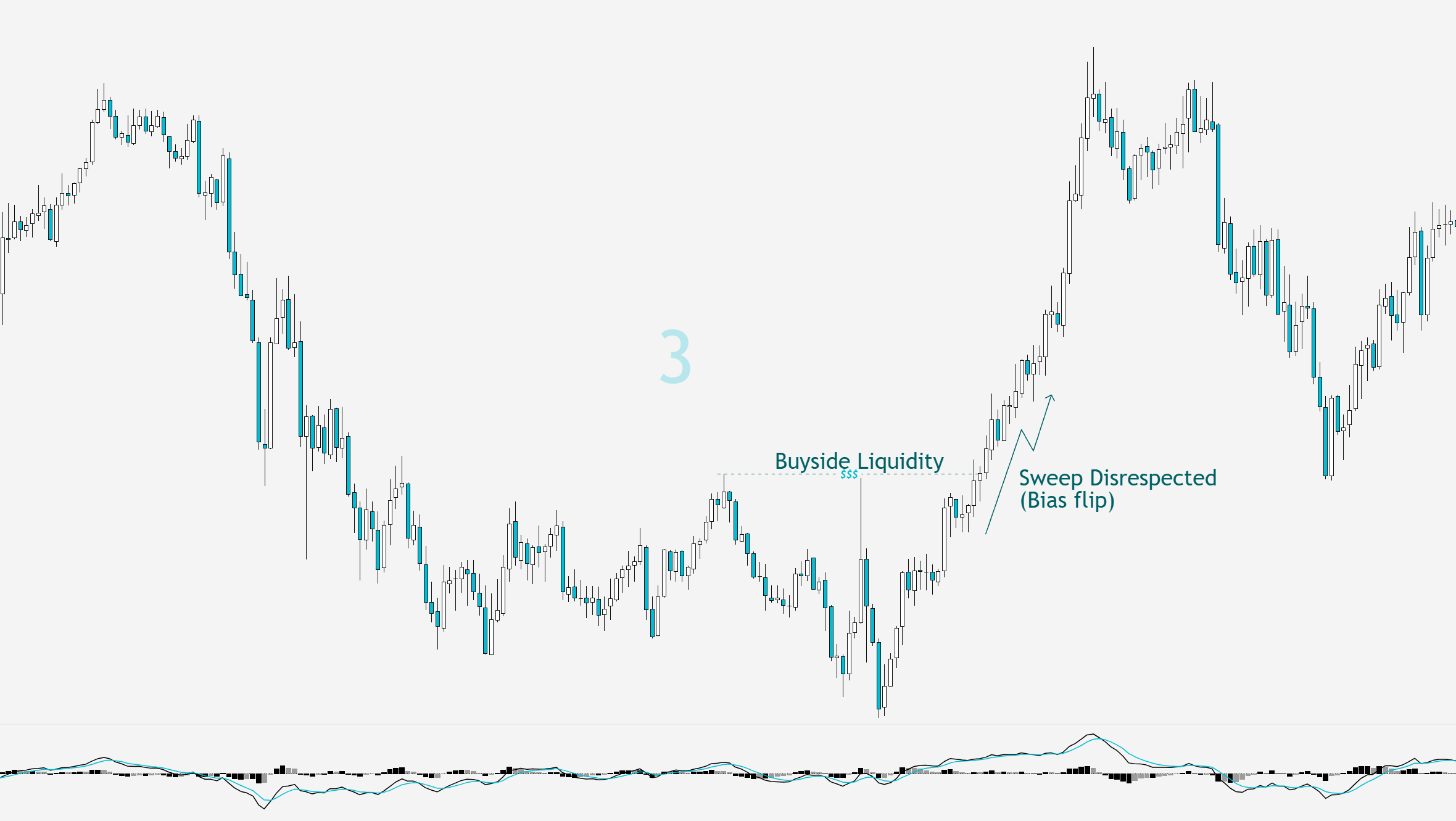
- Price runs straight through the FVG. It ignores the level and keeps going, then starts building structure the other way. That's not a failure — it's a possible bias flip, and the model has a separate entry for it. See What Is a Bias Flip?.
So the FVG isn't just a line on the chart — it's a decision point. How price treats it tells you whether you're trading continuation or reversal.
The one thing to take away
When you mark FVGs, only keep the unmitigated ones in the trend leg, and prioritise the ones on the right side of the 50% mark — discount in an uptrend, premium in a downtrend. A gap on the wrong half of the leg is a lower-quality level, even if it's the closest one.
Where this fits
This post is about the level — the imbalance you wait at. The actual entry trigger, the rejection and break of structure that gets you in, is covered in What Is a Bias Flip?. And the sweep that often drives price into these gaps in the first place is in What Is a Liquidity Sweep?.
Lewis trades the New York session live, in public, on YouTube and TikTok. Learning the LS Model? Start free with the public sessions and the sheets. The full course library is in The Debrief Plus.
Educational only. This is not financial advice. Trading leveraged instruments carries substantial risk, and past results don't guarantee future ones. The LS Model is a methodology. VIP alerts are free with an Exness account; you place each trade yourself. No Exness where you are? VIP comes included with The Debrief Plus or LSTrades Copy. Join the free Discord community to learn how the levels are mapped.
Free: the NY-open checklist
Get the session-prep checklist I run before the New York open.
The exact pre-market routine: the 30m read, the level, the risk rules, the debrief. Plus The NQ Edge letter. No hype.
VIP signals are free with Exness
My trades and our bot's trades, in your Telegram.
Entry, stop, targets, and the management as it happens, losses included. Free with an Exness account under the partnership.