
The Reversal Models: RM1 and RM2 Explained
The LSTrades indicator doesn't just detect entries. It classifies them.
Every signal that fires is assigned to one of three models: RM1, RM2, or CONT. The model tells you what kind of setup this is — and that context informs the grade, the conviction, and how you manage the trade.
This post covers the two reversal models: RM1 and RM2.
What a Reversal Setup Requires
Both RM1 and RM2 are reversal trades. They share the same core conditions:
- A liquidity sweep — price takes out a prior swing high (for a short) or swing low (for a long) and reverses
- An iFVG inversion — price creates a Fair Value Gap on the reversal, then retraces into that gap from the opposite side
These two conditions define the minimum requirement for any reversal signal. Without a confirmed sweep and a confirmed iFVG, the indicator does not fire.
What separates RM1 from RM2 is the additional layer of higher-timeframe (HTF) context present in RM1.
RM1: Reversal Model 1 (With HTF FVG)
Definition: A reversal setup where the liquidity sweep occurs at or near a Fair Value Gap on the 15-minute, 1-hour, or 4-hour timeframe.
The full sequence:
- Price sweeps a prior swing high or low
- That sweep coincides with a higher-timeframe FVG (15m, 1H, or 4H)
- The reversal candle creates a 5-minute FVG
- Price retraces into that 5-minute FVG, inverting it
The HTF FVG alignment is what elevates RM1. When the liquidity sweep happens at the same location as a higher-timeframe imbalance, there are two independent reasons for price to reverse at that level — not just the 5-minute sweep.
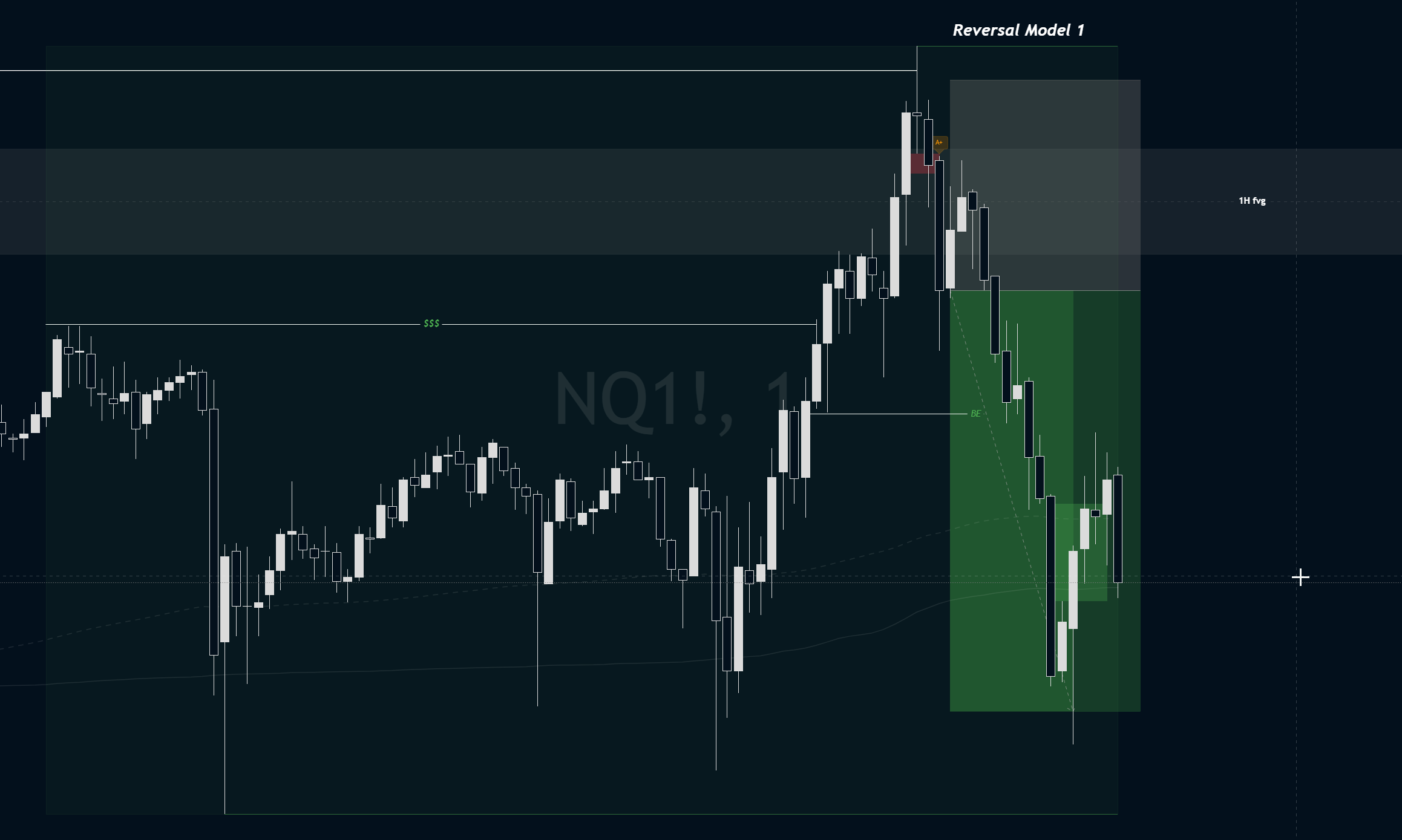
Grade floor: RM1 signals start at A-grade (base model conditions met). The presence of the HTF FVG already provides structural confluence, but the grade can still be elevated to A+ or A++ if CISD or BPR alignment is also present.
Why it matters: Institutional order flow tends to be concentrated around HTF imbalances. When a sweep happens at an HTF FVG, it's more likely that the reversal reflects genuine institutional intent rather than a temporary retracement.
RM2: Reversal Model 2 (Without HTF FVG)
Definition: A reversal setup where the sweep and iFVG conditions are met, but there is no higher-timeframe FVG in the vicinity.
The full sequence:
- Price sweeps a prior swing high or low
- The reversal candle creates a 5-minute FVG
- Price retraces into that FVG, inverting it
- No HTF FVG is required at the sweep level
RM2 is the "clean sweep, no overhead HTF context" trade. The core mechanics are identical to RM1 — sweep, FVG creation, iFVG inversion — but the trade doesn't have the HTF imbalance backing it.
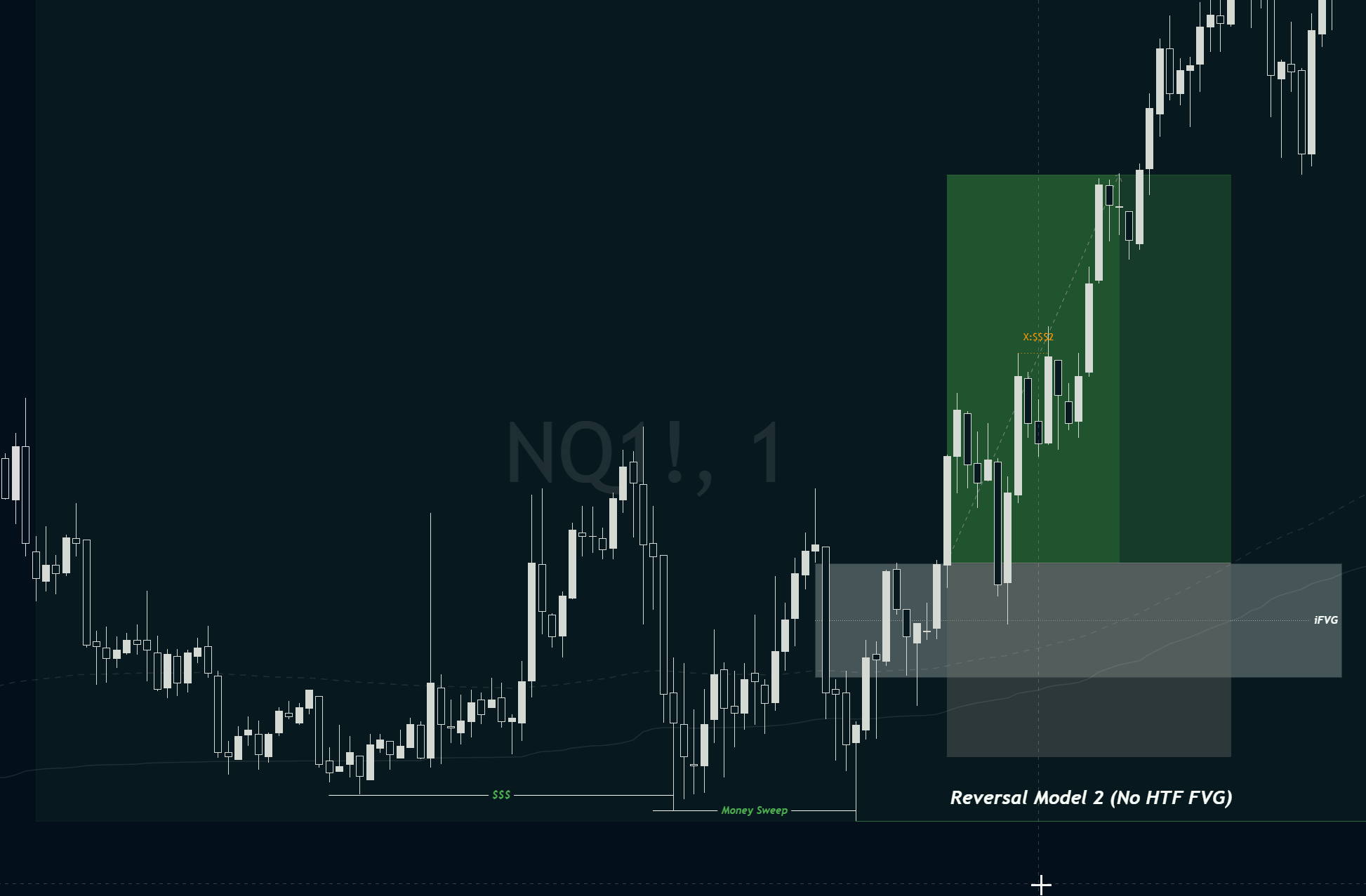
Grade floor: Same A-grade base as RM1. RM2 can reach A+ or A++ if confluence factors (CISD, BPR) are present.
Why it still fires: The sweep and iFVG combination is the primary signal logic. An RM2 setup is still a valid trade — the sweep took real liquidity, and the iFVG inversion shows price defending that reversal. Many clean RM2 setups reach TP2 without HTF FVG alignment.
Comparing RM1 and RM2
| Feature | RM1 | RM2 | |---------|-----|-----| | Liquidity sweep required | Yes | Yes | | 5-minute iFVG required | Yes | Yes | | HTF FVG at sweep level | Yes | No | | Minimum grade | A | A | | Can reach A++ | Yes (with CISD + BPR) | Yes (with CISD + BPR) |
The key practical difference: RM1 gives you two structural reasons for the reversal. RM2 gives you one. Both are valid, but RM1 setups at HTF FVG levels represent the strongest alignment between timeframes.
How the Grading System Interacts With Models
Model classification and grading are separate systems that work together.
The model tells you what conditions were present:
- RM1: sweep + HTF FVG + iFVG
- RM2: sweep + iFVG (no HTF FVG)
The grade tells you how much additional confluence was detected:
- A: base model conditions met
- A+: one additional confluence factor (CISD on 5m, or BPR)
- A++: two or more additional confluence factors
An RM2 A++ setup (sweep, iFVG, plus CISD and BPR alignment, but no HTF FVG) can be more compelling than an RM1 A setup (sweep, HTF FVG, iFVG, no additional confluence). Context matters.
When to Apply More Scrutiny
Both models are valid entries by the LSTrades system's rules. But there are conditions where you might apply additional judgment:
Higher scrutiny on RM2:
- If you're trading counter-trend (e.g., a bearish RM2 setup in a strong bull market structure on the 1-hour)
- If the RM2 is at a "generic" level with no structural reason for the sweep beyond price reaching that point
Higher conviction on RM1:
- When the HTF FVG being swept is on the 1-hour or 4-hour (not just 15-minute)
- When the sweep + HTF FVG alignment is very clean — price touched the FVG and reversed sharply
Understanding the model behind a signal helps you calibrate confidence. It doesn't override the system's rules, but it informs how you manage the trade within those rules.
The Third Model
There's a third signal type that behaves differently from both RM1 and RM2: the Continuation Model. Instead of trading reversals, it trades with the established trend after a sweep confirms directional intent.
The Continuation Model: Trading With the Trend on NQ explains when it fires and how it differs from the reversal models.
Deeper reading: Top-Down Analysis explains how HTF context is evaluated before the 5-minute entry. How to Grade Trade Setups covers the full A/A+/A++ grading system. Or join the free LSTrades Discord to see model + grade called out on every live signal.
Want live signals?
Get A-graded NQ setups delivered to Discord in real-time.
Every signal includes entry, stop loss, and two take-profit targets. No screen time required.